
By Francis Bordeleau-Martin and Alexandre Terrigeol
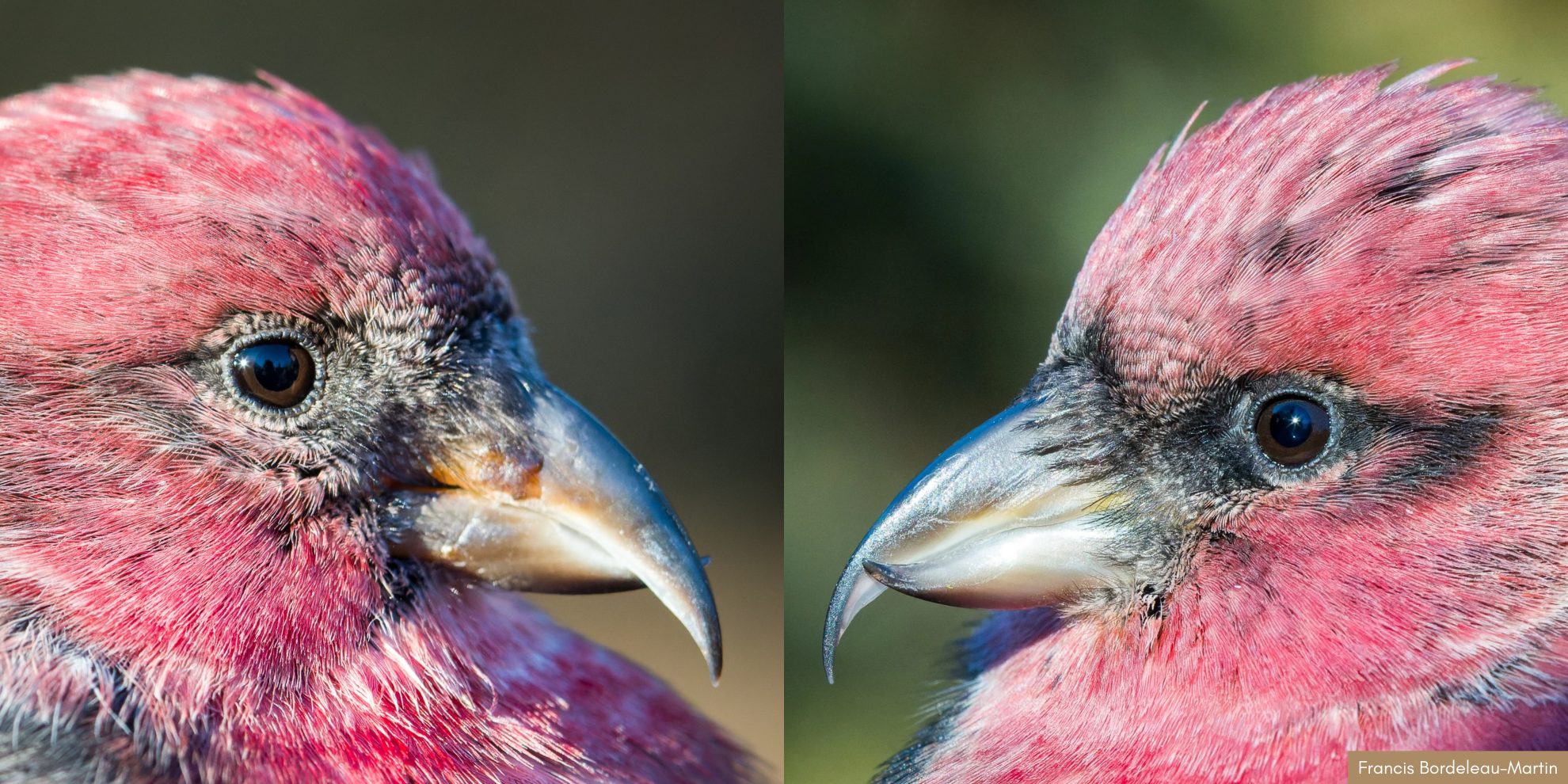
Did you know that some crossbills have a lower mandible that crosses to the right of the upper mandible, while in others, the crossing occurs to the left? Coincidence or a true evolutionary advantage?
A relentless search for food
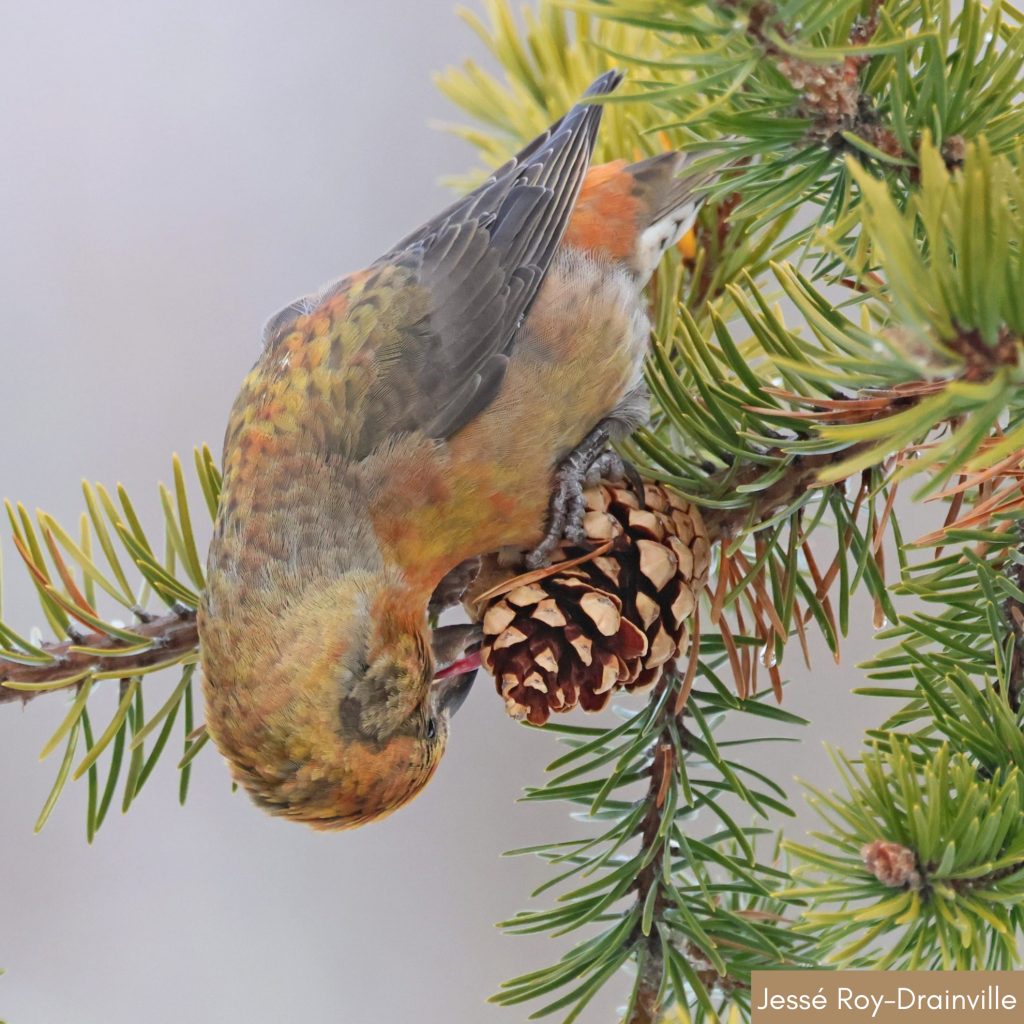
Two species of crossbills can be observed in the North Shore. Their numbers vary from year to year, ranging from just a few individuals to tens of thousands.
Often best observed at the Tadoussac dunes, crossbills are irruptive* birds whose presence is closely tied to the abundance of conifer seeds hidden inside their cones. Their movements and abundance in the forest are therefore directly linked to food availability. They are also the only group of birds to have a truly crossed bill.
This unique anatomical feature is an adaptation that allows them to extract seeds from conifer cones very efficiently. However, while this highly specialized bill makes feeding easier, it limits their ability to consume other types of food.
*A large-scale movement of birds beyond their usual range, occurring on a regular or irregular cycle, but not following an annual migratory cycle.
A complementary relationship between left- and right-billed birds
Given this high degree of dietary specialization, researcher Craig W. Benkman proposed the hypothesis that the coexistence of the two types of individuals could be favoured within a population. Indeed, when feeding, crossbills move quickly from one cone to another, often leaving seeds behind.
It is therefore possible that left-billed and right-billed individuals extract different seeds, leaving some seeds accessible to one another. This complementarity could help promote the coexistence of both types of individuals within the same population!
Not all crossbills are created equal!
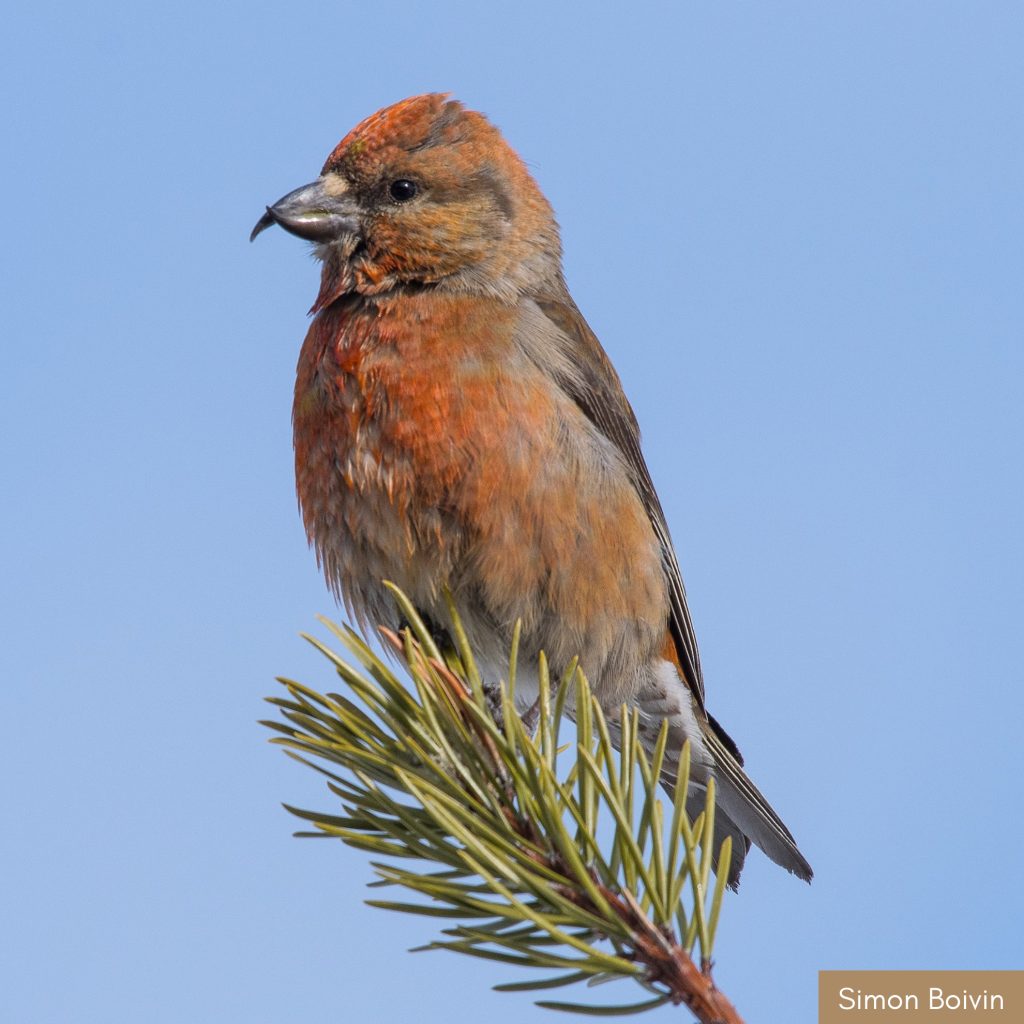
However, the proportion of left-billed and right-billed individuals appears to vary depending on the species, as well as on the type and condition of the cones they consume. For example, in several populations of Red Crossbills that feed exclusively on cones still attached to trees, the proportion is generally around 50% left-billed and 50% right-billed individuals.
In contrast, among White-winged Crossbills, the ratio is different: right-billed individuals are more numerous, with approximately two to three right-billed birds for every left-billed one. One possible explanation lies in the species’ dietary specialization. With its smaller bill, the White-winged Crossbill is regularly observed feeding on seeds from spruce cones, but also from larch, alder and birch. It can also feed on cones that are still attached to trees or those found on the ground.