By Jessé Roy-Drainville
In winter, when snow covers the dunes of Tadoussac and the Cap-Tourmente national wildlife area and migratory birds have left the Côte-Nord, one might imagine that the Tadoussac Bird Observatory (TBO) puts its activities on hold. That is not the case! On the contrary, it is still a very busy time for the team.

A busy season beneath the snow
For several years now, a major task has occupied our team of ornithologists for much of the winter: the meticulous analysis of thousands of bird sound recordings collected across Quebec, notably using the WildTrax platform.
Initially mandated by the Canadian Wildlife Service and the First Nations of Quebec and Labrador Sustainable Development Institute (IDDPNQL), as part of the Pineshish-Piyaasiis initiative, we have seen a growing number of partners entrust us with this type of work over time.
This sustained experience has allowed us to develop a strong bioacoustics component, supported by proven methods and in-depth knowledge of bird vocalizations. Today, we are able to produce reliable and detailed portraits of avian biodiversity across Quebec.
In the context of conservation, land-use planning, or wildlife monitoring projects, the quality and rigor of our analyses provide critical support for informed decision-making.
WildTrax and ARUs: revolutionizing bird studies
WildTrax is a Canadian online platform used to manage, store, analyze, and share sound data collected in nature. These data are gathered using small devices called automated recording units (ARUs).
These weather-resistant devices are equipped with one or two microphones and record ambient sounds at pre-programmed times. They are deployed in spring or winter in the study areas and retrieved the following fall or winter. This means they “listen” throughout the entire bird breeding season.
Since many projects use dozens or even hundreds of recorders, and multiple projects run simultaneously, this quickly results in thousands of hours to analyze! Fortunately, a pre-selection process allows us to listen to a sufficient sample of recordings to accurately assess avian diversity. One clear advantage: this work can be done indoors, in warmth… and away from mosquitoes!

This tool is extremely valuable, as it allows us to study remote or hard-to-access areas and collect data without disturbing wildlife. Some projects are carried out in collaboration with Indigenous communities, who help deploy recorders on their traditional territories. This enriches the data with valuable local ecological knowledge and helps refine our understanding of bird distribution across the boreal forest.
Artificial or human analysis?
Artificial intelligence tools such as BirdNET, HawkEars, or Merlin can assist in identifying certain bird species, but they are not yet fully reliable. Errors can occur when birds are far from microphones, when background noise is high, or when multiple birds are singing simultaneously. That is why the trained ear of ornithologists remains essential for accurate analysis and to avoid incorrect results.
The analysis process follows a rigorous method. Audio files are first uploaded to WildTrax, allowing them to be accessed from anywhere with an internet connection. Ornithologists then examine them one by one, listening while observing a sonogram (or spectrogram), which is a visual representation of sound. Time is displayed from left to right, and sound frequency (low to high) from bottom to top.
Small bands at the top also show species automatically detected by artificial intelligence. These suggestions can be helpful in cases of uncertainty, but final identification is always confirmed by ornithologists.
An example with a recording
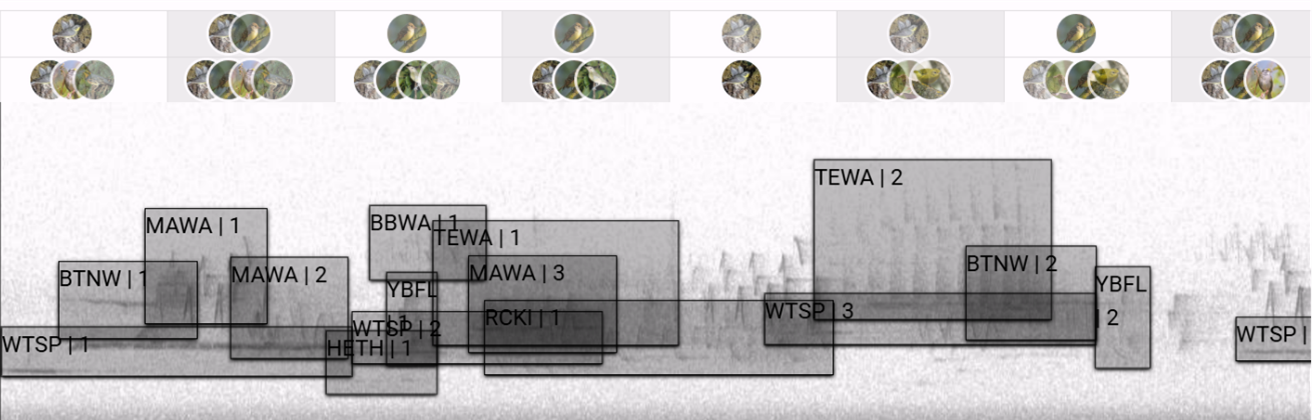
In this recording from the boreal forest of northern Quebec, you can see, for example, that our team identified 16 individuals belonging to 9 different species. All in just 12 seconds. The top portion corresponds to the left microphone, and the bottom to the right microphone. Time markers (0 s, 5 s, and 10 s) appear along the bottom. The boxes indicate identified birds, using a four-letter code and a number for each individual (for example, “WTSP | 1” for a White-throated Sparrow, “BTNW | 1” for a Black-throated Green Warbler, or “MAWA | 2” for a Magnolia Warbler).
Small bands at the top also show species automatically detected by artificial intelligence. These suggestions can be helpful in cases of uncertainty, but final identification is always confirmed by ornithologists.
From sound signals to identifying individuals
Ornithologists analyze recordings by drawing a “tag” around each bird song. They then identify the species and estimate the number of individuals present.
Indeed, the goal is not only to identify species, but also to determine how many birds are present. To distinguish individuals, specialists rely on several clues: overlapping songs, differences in intensity (indicating distance), and the position of birds relative to the recorder.
Most recorders have two microphones facing opposite directions. When listening with headphones, sounds are heard in stereo, as if birds were surrounding the listener. This greatly helps differentiate individuals. For example, a bird heard in only one ear is likely on one side of the recorder, while another heard in both ears and louder is probably closer.
Additionally, even though birds of the same species sing similarly, each individual often has its own subtle “acoustic signature”, much like an accent. Just as with humans, even if two people speak the same language, their voices are rarely identical.
In short, this meticulous analysis transforms hours of listening into reliable and useful scientific data.
Science, collaboration, and conservation: the potential of sound recordings
Beyond the analysis itself, these recording projects offer tremendous potential. They make it possible to survey natural environments at lower cost and with high precision, particularly in areas where very little information is available. They also help detect species at risk and support the creation of protected areas.
In the longer term, these data open the door to new research projects and contribute to building the team’s expertise in a rapidly growing field: bioacoustics, the study of sounds produced by animals.
They also help improve our understanding of the major changes affecting bird habitats—such as climate change, human activities, forest fires, and insect outbreaks—in remote regions of Quebec where access is very difficult.
Looking ahead
In conclusion, the OOT is actively expanding its scientific service offerings, whether in bioacoustics, case studies, or scientific analyses. Each new project broadens territorial coverage, strengthens knowledge about Quebec’s birds, and ensures a more stable future for the team of ornithologists.
Winter is therefore not a time of rest for our young and growing team. Rather, it is a season during which, patiently and passionately, we transform thousands of hours of recordings into concrete data to better understand, and ultimately, better protect our birds.