
By Clara Casabona
The Short-eared Owl (Asio flammeus) is one of the most widely distributed raptors in the world. However, in North America, its populations are declining, and in Canada, the species has recently been recommended for designation as a threatened species. In Quebec, it is estimated that there are fewer than 100 breeding pairs remaining.
Solving a technical challenge
To better protect the species, it is essential to know where it breeds and how its populations are changing. However, the Short-eared Owl is particularly difficult to detect. Unlike many other owls, it nests directly on the ground in grasslands, farmland, and wetlands. It is not very vocal, is active mainly at dawn and dusk, and may also change its breeding site from one year to the next depending on environmental conditions. All these characteristics complicate population monitoring and conservation efforts.
To address these challenges, a study was conducted to better understand the habitats used by the Short-eared Owl and the factors that could improve its detection. The study addressed three main questions:
- What habitats are most favorable for its breeding?
- Does it return to the same sites from one year to the next?
- Can certain bird species help detect it?
Where are the best habitats?
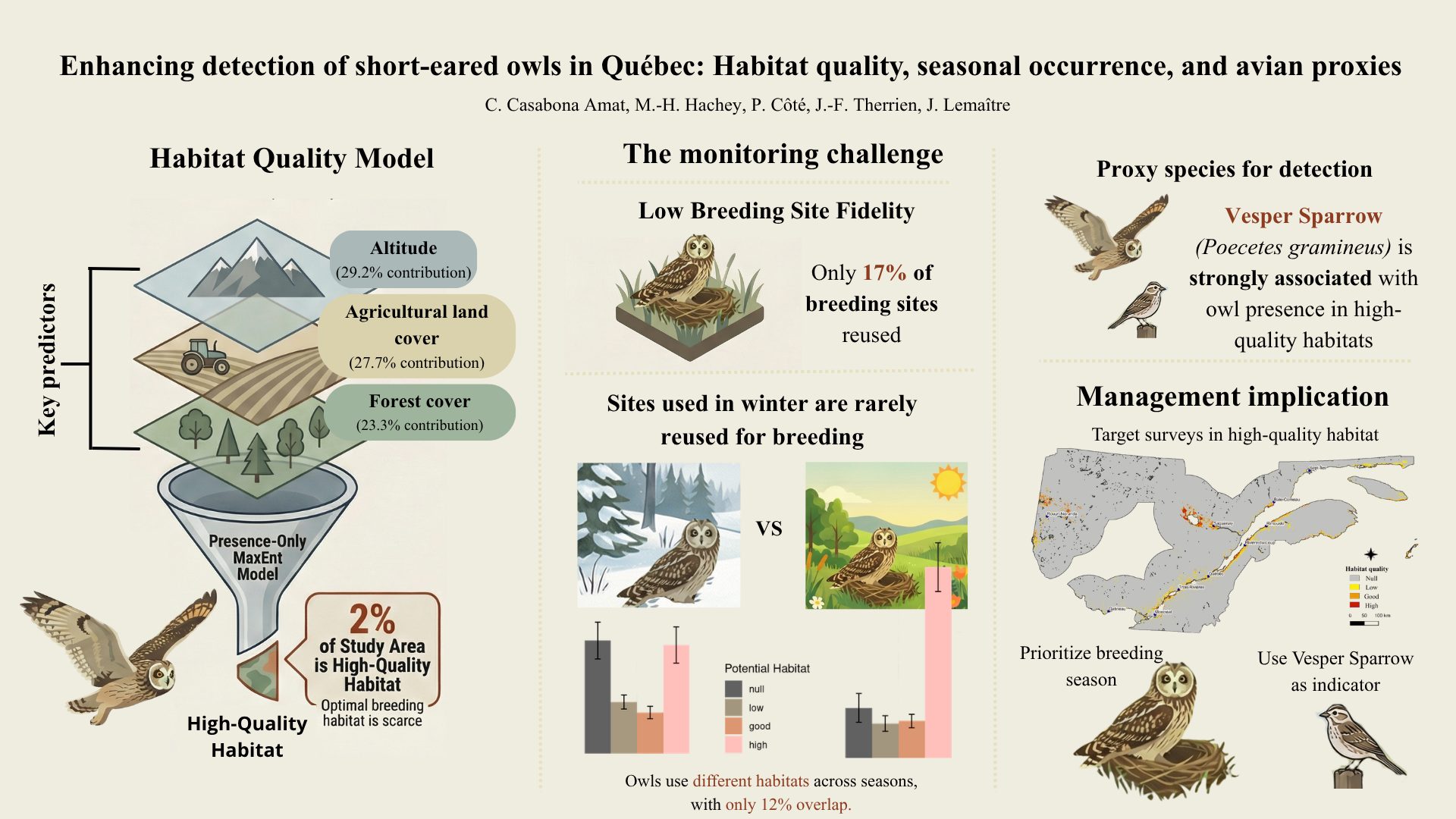
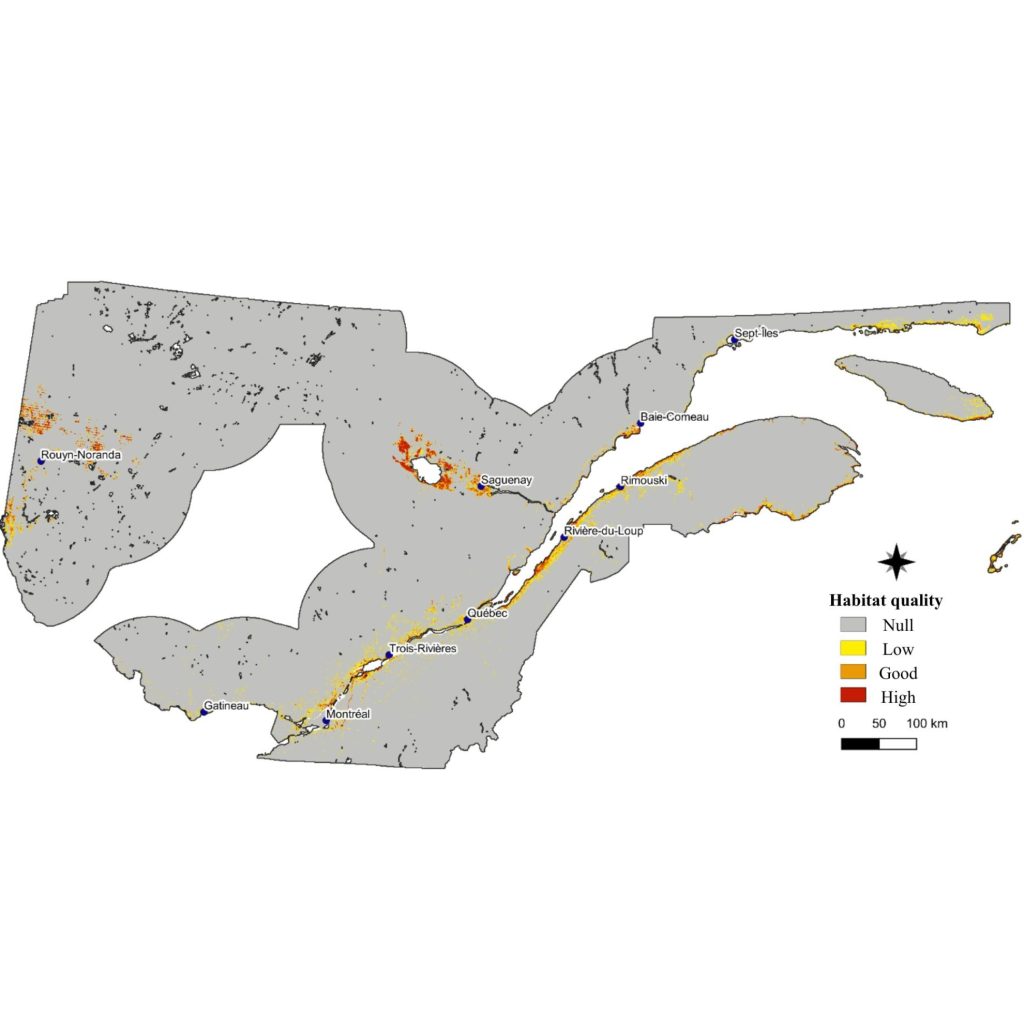
More than 25 years of observations from the SOS-POP program, combined with various environmental data, have made it possible to develop a model that predicts the habitats most favorable for the reproduction of the Short-eared Owl in southern Quebec.
The model quickly highlights an important fact: despite the vastness of the studied area, only 2% of it offers conditions considered to be of very high quality for the species. These habitats are mainly located at low elevations, in vast open landscapes where farmland plays a significant role but does not completely dominate the landscape. Conversely, large forested areas offer few favorable conditions for the Short-eared Owl. Validation of the model using independent data from eBird and NatureCounts showed that more than 70% of breeding observations occurred in habitats classified as good or excellent. The model therefore effectively identifies the areas most favorable to the species.
A bird that often changes its address
Unlike territorial species, the Short-eared Owl exhibits a high degree of mobility. Only 17% of breeding sites were occupied for several years, and barely 6% were occupied for two consecutive years.
In winter, the birds show slightly greater site fidelity, but these sites rarely correspond to the areas used for breeding. In other words, observing a Short-eared Owl in winter does not allow us to predict where it will nest the following summer. This mobility may be linked to fluctuations in the populations of small rodents, its primary food source, whose abundance varies greatly from year to year.
When one bird reveals another
Species that inhabit the same habitats can sometimes serve as indicators for locating a rarer species. To assess this possibility, more than 131,000 eBird checklists were analyzed in the high-quality habitats predicted by the model. Bird communities observed in areas where the Short-eared Owl had previously been detected were compared to those at comparable sites where it had never been observed.
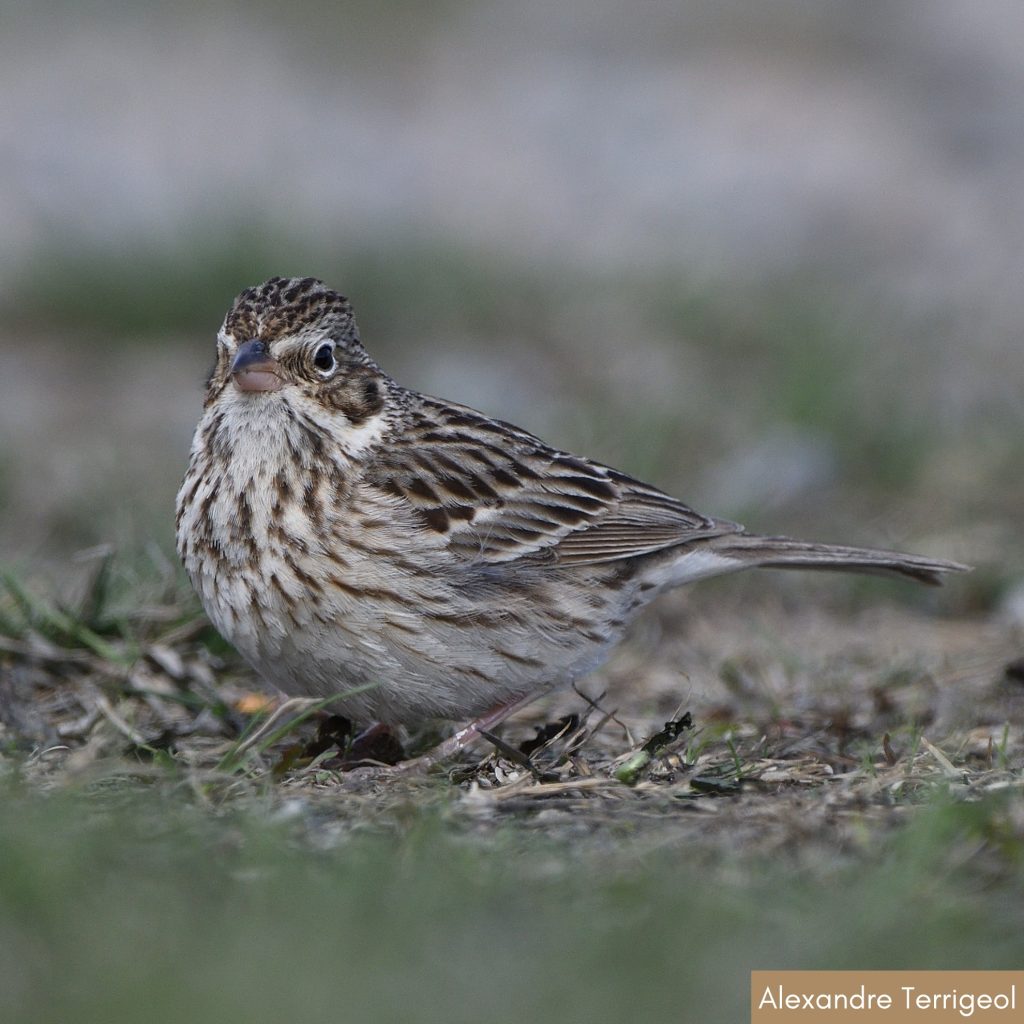
Among the 195 species studied, the Vesper Sparrow showed the strongest association with the Short-eared Owl. It was observed nearly three times as often at sites occupied by the Short-eared Owl. These results suggest that the Vesper Sparrow could become a valuable ally during surveys. Its song, which is much easier to detect than the Short-eared Owl’s discreet presence, could help biologists target areas where the probability of detection is highest.
In conclusion
The Short-eared Owl remains one of the most difficult raptors to monitor in Quebec. Its cryptic behavior, frequent movements, and the gradual transformation of open habitats complicate its conservation. Beyond providing a better understanding of the species, this research offers concrete tools to improve conservation efforts. By combining data from citizen science, habitat modeling, and bird community analysis, this study proposes new approaches to better identify the habitats most favorable for breeding and improve detection of the species. As open habitats continue to disappear or change, these tools will help focus efforts on areas where they will have the greatest impact.
To re the full article : Casabona Amat, C., Hachey, M.-H., Côté, P., Therrien, J.-F., & Lemaître, J. (2026). Enhancing detection of short-eared owls in Québec: Habitat quality, seasonal occurrence, and avian proxies. Journal of Wildlife Management, 90, e70238. https://doi.org/10.1002/jwmg.70238